Enter your shipment number.

Recent Changes in the EU’s Customs Rules
EU finalizes its trade agreement with the U.S. and introduces new customs rules for low value goods
1 July 2026
The EU/USA trade deal will finally move forward after the EU bloc gave its final sign-off, ending a year of ratification talks.
The European Union has officially approved the long-awaited EU-U.S. trade agreement, which intends to strengthen transatlantic trade by reducing barriers and providing greater certainty for businesses operating between the two markets through its expiration in 2029.
- The EU will eliminate tariffs on U.S. industrial goods and some agricultural products in exchange for a 15% tariff ceiling on its exports to the U.S.
- The two sides still haven’t reached a consensus on key issues like metals or tech regulations.


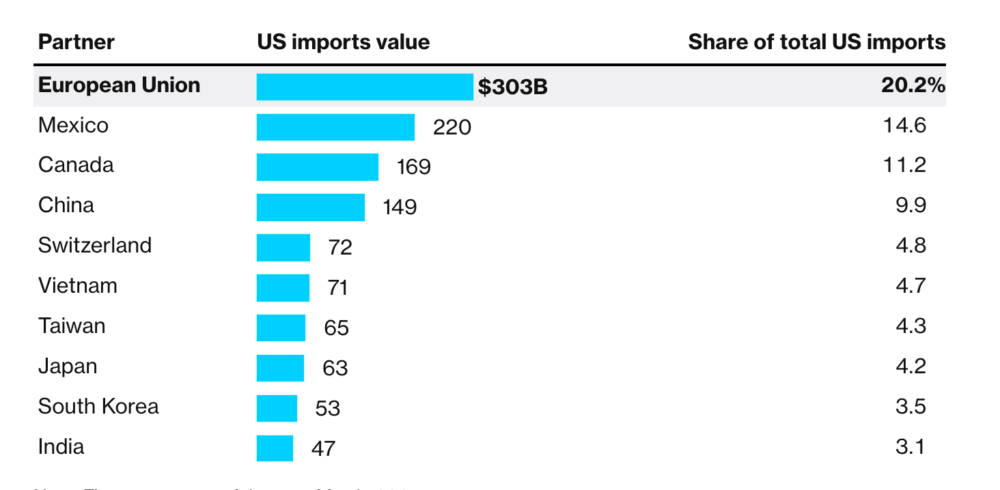
The European Union remains the biggest source of the United States’ imports. Together, the EU and the United States maintain the world’s largest bilateral trade and investment relationship and the most integrated economic partnership, totaling €1.6 trillion in goods and services traded in 2024—more than €4.2 billion crossing the Atlantic each day. This represents almost 30% of the global trade in goods and services and 43% of global GDP.
Note: Figures are sums of January–May 2025. Source: U.S. Census Bureau, Bloomberg.
On July 1st, the European Union made significant changes to its customs rules for low-value goods, removing the duty-free exemption for goods valued at €150 or less.
Under the new temporary framework:
- A flat €3 customs duty applies to each qualifying item in a shipment valued under €150.
- If a shipment contains products from multiple tariff classifications, the duty may apply separately to each applicable product category.
- Importers or sellers are responsible for declaring and paying the applicable customs duties during the clearance process.
- The temporary flat-fee regime will remain in effect until July 1, 2028, while the EU continues implementing broader customs reforms.
What this means for shippers: New opportunities and new compliance requirements.
Companies that export qualifying U.S. goods to the European Union may benefit from reduced or eliminated tariffs, while businesses shipping high volumes of low-value parcels into the EU should review their landed cost calculations, pricing strategies, and customs processes to account for the new duty requirements.
Now is an ideal time for importers and exporters to evaluate their supply chains, confirm product classifications, and ensure customs documentation is accurate to maximize their available trade benefits and maintain compliance.
Need Assistance?
OIA Global offers customs brokerage consultations to help shippers navigate the EU’s complex regulatory environment. Our customs brokerage and trade compliance specialists can assist with tariff classification, customs declarations, duty optimization, and regulatory compliance to help keep your supply chain moving efficiently.

Related content
-

IEEPA Refunds & CAPE System Updates
Below is the latest information on what has changed, who qualifies, and what to expect next.
-

Tariff Updates
Rates, country designations, and trade rules are all subject to change.
-

Monthly Market Report
These informative and comprehensive documents highlight critical supply chain news and events, with information sourced from the industry’s leading sources.