Nhập số lô hàng của bạn.

Market Report - 5/2026
Những tài liệu đầy đủ thông tin này nêu bật các tin tức và sự kiện quan trọng trong chuỗi cung ứng, với thông tin được thu thập từ các nguồn hàng đầu trong ngành.
OIA Global tạo ra báo cáo thị trường toàn diện mỗi tháng!
Các phần nội dung
- Xu hướng thị trường
- Sáp nhập và mua lại
- Cơ sở hạ tầng
- Luật và Pháp chế
- Tính bền vững
- Công nghệ vận tải
Xu hướng thị trường
China Railways (CR) introduced new inter-city express freight trains as well as intermodal services between major economic centers like the Yangtze River Delta and the Greater Bay Area. CR’s goal is to provide more integrated logistics over long distances.

The pricing for transit slots to navigate the Panama Canal—both Neopanamax and Panamax lock sizes—has jumped to record highs, roughly 5x greater than before the Iran conflict started.

Air cargo operations are returning to Venezuela, with new service options and widebody capacity.
Amazon Opens Logistics Network to All Businesses
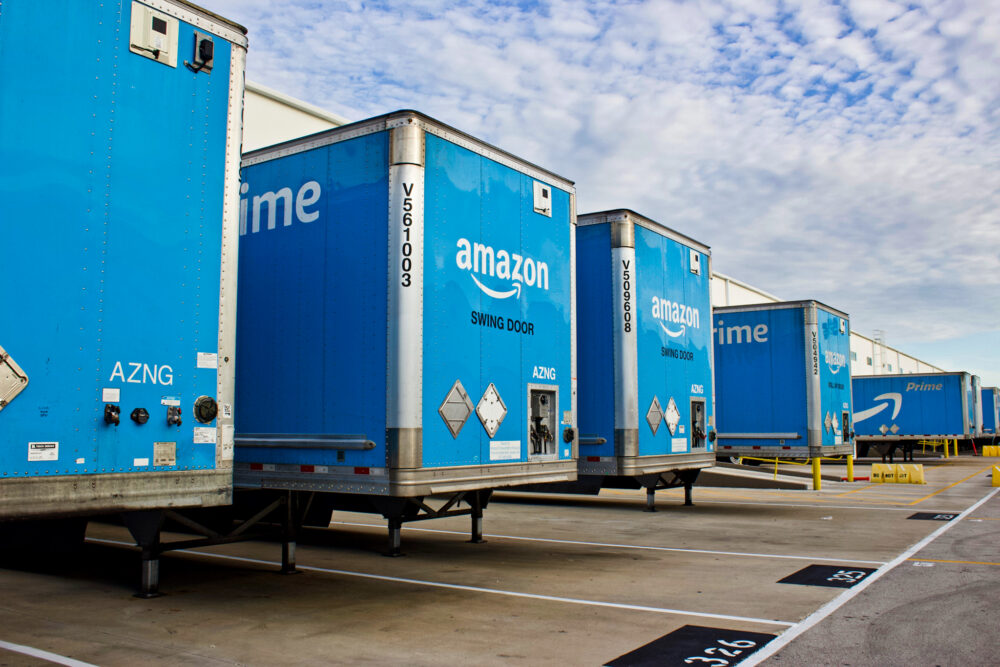
Businesses of all types and sizes now have access to Amazon’s logistics network, including the company’s entire portfolio of freight, distribution, fulfillment, and parcel shipping solutions. Amazon Supply Chain Services (ASCS) includes a network of 200+ U.S. fulfillment centers, 80,000+ trailers, 24,000+ intermodal containers, and 100+ aircraft.
India’s Government Continues Domestic Growth Plan

Vận tải đường biển
Sarbananda Sonowal, India’s Minister of Ports, Shipping, & Waterways, wants to add 62 new vessels to India’s domestic maritime fleet in FY ‘26-’27, with the government providing a $5.4B investment. Overall, the goal is to add 2.85M gross tons to India’s fleet.
India’s government approved the Bharat Maritime Insurance Pool (BMI), a domestic insurance program that will ensure Indian flagged or controlled vessels have access to affordable maritime insurance, even when transiting volatile routes. The plan includes a financial commitment of about $1.4B.
Vận tải hàng không
- India’s government wants to move 10M tons of air cargo annually by 2030. The sector currently handles around 4M tons.
- The country is opening 50+ new airport facilities
- Air India has roughly 600 new aircraft on order
Collaboration with South Korea

South Korea and India agreed to deepen supply chain cooperation as the two countries will combine South Korean shipbuilders’ expertise with India’s support for ship production, with the goal of doubling bilateral trade to $50B by 2030.
Strait of Hormuz: Latest Updates
Roughly 130 container ships remain stuck or delayed in the Persian Gulf, and the U.S. is now helping ”guide” stranded ships to safety.
Even after the conflict is over, it could take months for ships to be cleared for transit in the Strait of Hormuz because Iran has mined the narrow waterway that guards the entrance to the waterway.
- Carriers are still avoiding the region despite ceasefire announcements
- Cargo is increasingly being rerouted via rail/road land bridges
- Elevated fuel surcharges will persist through Q2

Jet Fuel Crisis
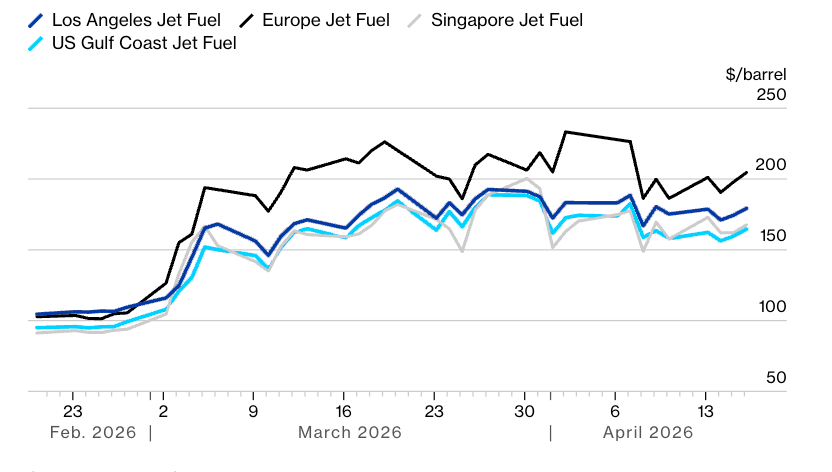
Jet fuel rose 106.6% year-over-year (YoY), reaching its highest level in more than 23 years. This has pushed cargo yields up, creating an inflationary pricing environment. Fuel costs—not demand—are now the primary driver of freight pricing.
- For carriers: margin protection through surcharges. The world’s 20 largest airlines are cancelling flights, reducing global capacity overall.
- For shippers: higher costs and volatility even in a soft market environment.
- Consumers will be forced to absorb the extra costs of jet fuel through new fees for bags, seats, etc.
Xu hướng thị trường (Tiếp theo)
Top Concerns for Trucking Carriers: Insurance & Litigation
For many in the trucking industry, the issue is not just the cost of insurance but also the structural imbalance between outdated regulatory requirements and the financial realities of litigation.
- Nuclear verdicts—lawsuits exceeding $10M—are rising sharply, driving up insurance costs and increasing financial risk for carriers.
- Outdated federal insurance minimums are exposing trucking fleets to liabilities far beyond what they can afford.
A vicious cycle: Larger verdicts drive higher premiums, which contribute to financial strain and industry consolidation, reducing competition and leaving the remaining carriers with fewer options.



China Leveraging Third Parties to Limit Tariff Exposure
China continues to manage geopolitical risks and to limit tariff exposure by using third-party countries for its trade flows. In particular, Vietnam and Mexico have become strategic locations for Chinese producers. Many Chinese suppliers have relocated production to Vietnam or set up local entities and hired Mexican labor to qualify for preferential trade treatment under USMCA.
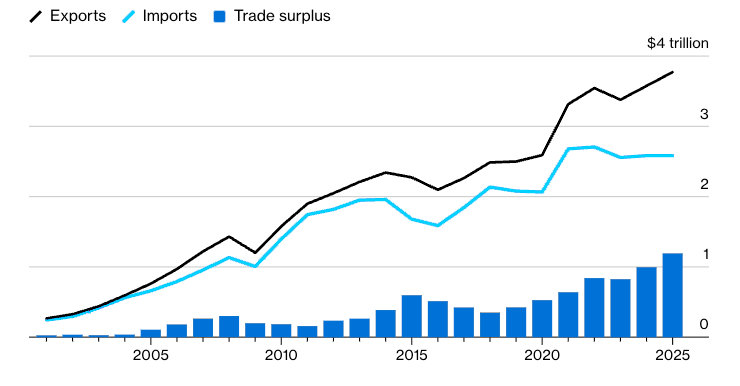
China’s trade surplus—exports outweighing imports—reached a new high ($1.2T) despite U.S. tariffs.
Source: China’s General Administration of Customs, Bloomberg.
The latest Ocean Shipping Index from E2open shows that supply chain disruptions are now happening downstream, later in the shipping process, which makes it harder to predict overall. Although performance at origin has improved, delays are shifting into the booking, transit, and unloading stages.
The leading ocean carriers’ aggressive growth is reflected via one key metric: the current order book of new ships is roughly 35% of the existing fleet. Plus, the world’s top 10 carriers control approximately 79-85% of the order book.
Cơ sở hạ tầng
The government in Ho Chi Minh City finally approved the development proposal for a transshipment port project, the $4.9B Can Gio International at the mouth of the Cai Mep River. The port will be built over an area of 570 hectares on an offshore islet and is designed to have a 4.8M TEU capacity by 2030, reaching 16.9M TEUs by 2047.
Landbridge Development

Thailand’s government will accelerate work on a Baht $1T ($USD 31B) project to build a 90km rail landbridge for container traffic across southern Thailand. The new landbridge would connect deepwater ports in Ranong and Chumphon provinces and create an alternative to the Strait of Malacca, one of the busiest shipping lanes in the world.


Saudi Arabia and Egypt are working on a new landbridge between the Arabian Gulf, the Red Sea, and the Mediterranean to provide a bilateral route that would bypass the Strait of Hormuz. The landbridge will link Gulf nations via rail across Saudi Arabia to Red Sea ports (Jeddah Islamic Port, King Abdullah Port, and the Port of Neom). Cargo would then be shipped across the Red Sea to the ports of Sokhna and Safaga and then via rail to Egypt’s Mediterranean coast port of Damietta.
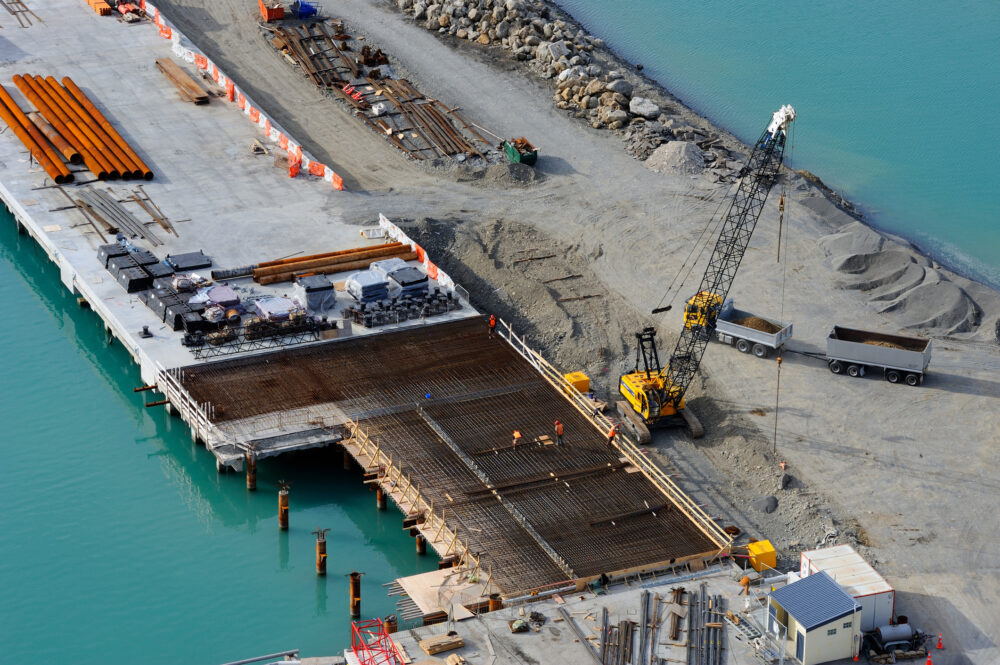
Port Newark Container Terminal (PNCT), the Port of New York and New Jersey’s third-busiest marine terminal, announced $100M in new container handling equipment and related facilities, the first step in a $1B plan to add a new berth and more rail capacity for its main customer, Mediterranean Shipping Company (MSC).
Georgia Port Authority’s 10-year investment plan projects five additional berths and a 54% increase in container capacity across its terminal network.
Luật và Pháp chế
IEEPA Tariff Refunds & CAPE Phase 1
U.S. Customs has established a new process—the Consolidated Administration & Processing of Entries (CAPE) system—to refund importers for voided International Emergency Economic Powers Act (IEEPA) tariffs. The Consolidated Administration & Processing of Entries (CAPE) system consists of four steps:
- Claim submission
- Mass processing
- Review and liquidation/reliquidation
- Refund delivery
According to a recent court filing, U.S. Customs and Border Protection (CBP) expects to start issuing refunds for invalidated IEEPA tariffs as soon as May 11th.
Since the launch of the Consolidated Administration & Processing of Entries (CAPE) portal on April 20th, the agency has accepted roughly 21% of all entries, with about 3% of those entries being liquidated and moved onto the refund process.
False Flags
The International Maritime Organization (IMO) is enacting new guidelines around how ships are registered to improve transparency and due diligence, and to hopefully reduce “false flags” in the shipping industry—an intentionally deceptive practice where a vessel illegally flies a country’s flag or uses fraudulent registration documents to conceal its true identity, ownership, or cargo.
- The guidelines are intended to close a key regulatory gap, since there is currently no binding international framework to regulate the registration of ships.

Luật pháp và Quy chế (Tiếp theo)
Mục 232 Thuế quan
The U.S. recently made significant updates to Section 232 tariffs for key metals (steel, aluminum, copper, etc.) as well as new tariff measures targeting pharmaceutical imports.
Metals
Key Changes (Effective April 6th, 2026, 12:01 a.m. ET)
Tariffs will now be assessed based on the full value of imported goods—not reduced foreign pricing.
- 50% tariff: Articles made entirely or almost entirely of steel, aluminum, or copper (e.g., coils, sheets).
- 25% tariff: Derivative products substantially made of these metals.
- 15% tariff (through 2027): Certain metal-intensive industrial and electrical grid equipment to support U.S. industrial expansion.
- 10% tariff: Products manufactured abroad using entirely U.S.-origin metals.
Exemption: Goods containing 15% or less of these metals are no longer subject to Section 232 tariffs.
Pharmaceuticals
100% tariff on patented pharmaceutical products and ingredients.
- Effective July 31st, 2026, 12:01 a.m. EST for larger companies
- Effective September 29th, 2026, 12:01 a.m. EST for smaller companies
Reduced tariffs (15%) apply to certain places: the EU, Japan, Korea, Switzerland, Liechtenstein, and the UK.
0% tariff available through Jan. 20th, 2029, for companies entering Most Favored Nation (MFN) pricing agreements with the U.S. Department of Health & Human Services, or those signing onshoring agreements with the Department of Commerce. 20% tariff applies if only the onshoring agreements are executed.
Sáp nhập và mua lại
Hapag-Lloyd is on track to complete its $4.2B takeover of Zim Integrated Shipping Services by the end of this year after shareholders voted overwhelmingly to approve the deal. The Hapag-Zim merger still needs approval from regulatory authorities in several jurisdictions before it can be completed.
Project44, a leading business intelligence tech company, acquired LunaPath, an AI-native logistics automation company specializing in orchestration and execution-focused agents. The acquisition accelerates project44’s AI Agent Orchestration strategy by embedding LunaPath’s automation capabilities to eliminate repetitive freight work and turn insights into coordinated, real-time execution grounded in a live operational context.
Tính bền vững
Net Zero Framework Delayed Again
Despite numerous setbacks and competing proposals, the International Maritime Organization’s (IMO) Net Zero Framework (NZF) remains alive, with carbon pricing still at the center of the debate. Negotiations were recently restarted, but were then immediately delayed until later in the year.
Last year, many countries provisionally agreed to a framework that commits the shipping industry to reach net-zero emissions by 2050, but legal adoption was derailed by several powerful countries.

China and European countries have backed the plan to impose a carbon price on emissions for ships >5,000 tons.
The United States and Saudi Arabia remain opposed to the framework and argued against restrictions on traditional fuels.
“The U.S. will explore all potential remedial options to protect American consumers from a disputed and unneeded global carbon tax.” – the Federal Maritime Commission (FMC)

Nội dung liên quan
-

Cập nhật biểu thuế
Rates, country designations, and trade rules are all subject to change.
-
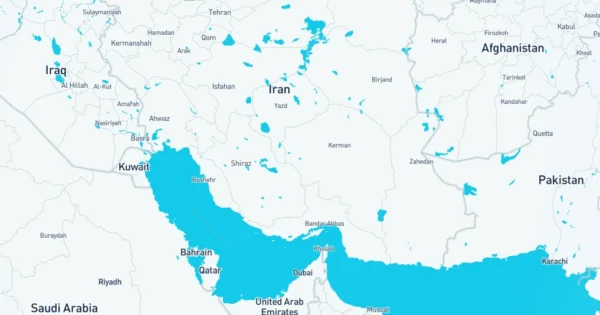
Cập nhật chuỗi cung ứng Trung Đông
The situation in the Persian Gulf remains fluid, and this page will be updated as new developments occur.
-

Báo cáo thị trường hàng tháng
Những tài liệu đầy đủ thông tin này nêu bật các tin tức và sự kiện quan trọng trong chuỗi cung ứng, với thông tin được thu thập từ các nguồn hàng đầu trong ngành.