出荷番号を入力する。

市場動向
West African ports are now routinely handling larger container vessels (10,000+ TEUs), demonstrating rapid growth in regional shipping capacity. Just a decade ago, vessels of around 3,500 TEUs were the norm. Key ports in this region include Lagos, Lekki, Tema, Abidjan, Kribi, and Lome.

Hapag-Lloyd will invest about $1B in India. The expansion program includes reflagging four ships to the Indian registry, ship recycling efforts, and developing terminal infrastructure at Vadhavan, a deepwater harbor project about 100 miles north of Mumbai.
Strait of Hormuz Crisis
Recent military action against Iran is disrupting global supply chains, affecting Middle East airspace and key trade routes throughout the Persian Gulf, including the Strait of Hormuz and Suez Canal. The situation remains fluid and will evolve minute-by-minute.
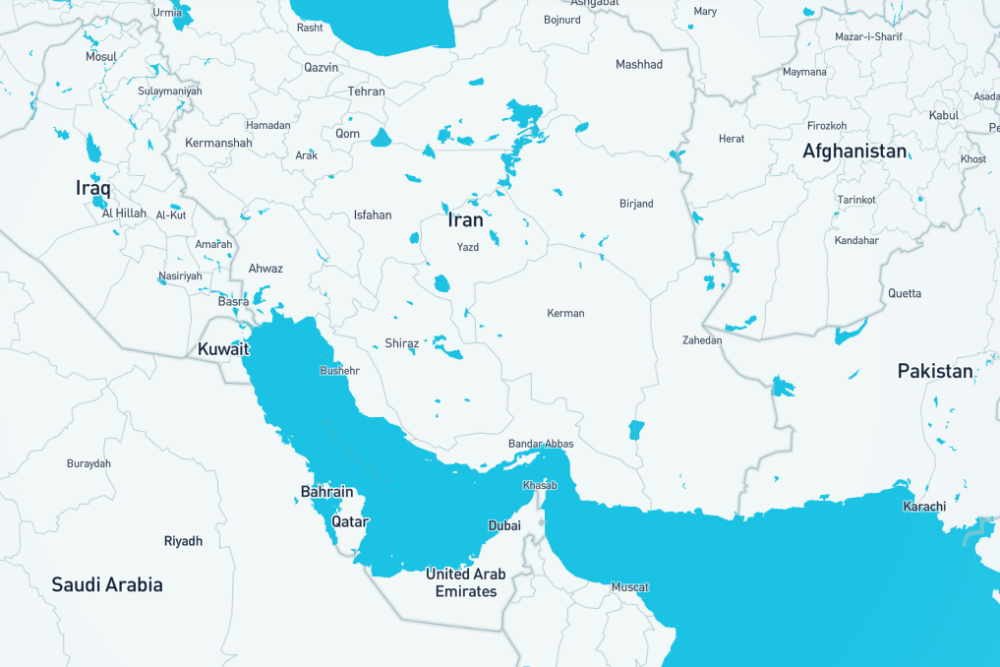
More than 34,000 ships diverted routes during the first four weeks of disruption in the Strait of Hormuz.
The U.S. is doubling its financial commitment (now $40B) to provide reinsurance guarantees for ships willing to travel through the Strait of Hormuz, and has secured new insurance partners, including AIG and Berkshire Hathaway. The U.S. is trying to encourage traffic to resume by easing shippers’ worries.
Dwell times are rising in India, Singapore and China with no indication of stabilization, pushing up container rates on critical east-west routes.
- Rate increases into India, Egypt, and East Mediterranean ports reflect the conflict-driven disruption in the Middle East.
- Carriers are actively designing new multimodal solutions that combine sea, rail, and road transportation to circumvent the affected areas.
- COSCO resumed new booking services for ordinary freight containers from the Far East to the Middle East.

Jet Fuel Costs Impact Trade Patterns
Wholesale jet fuel prices have more than doubled since the start of the conflict, surging past the previous records set after Russia invaded Ukraine. Jet fuel is particularly exposed to disruption because it can only be stored for about a year before it starts to degrade, depending on storage conditions.
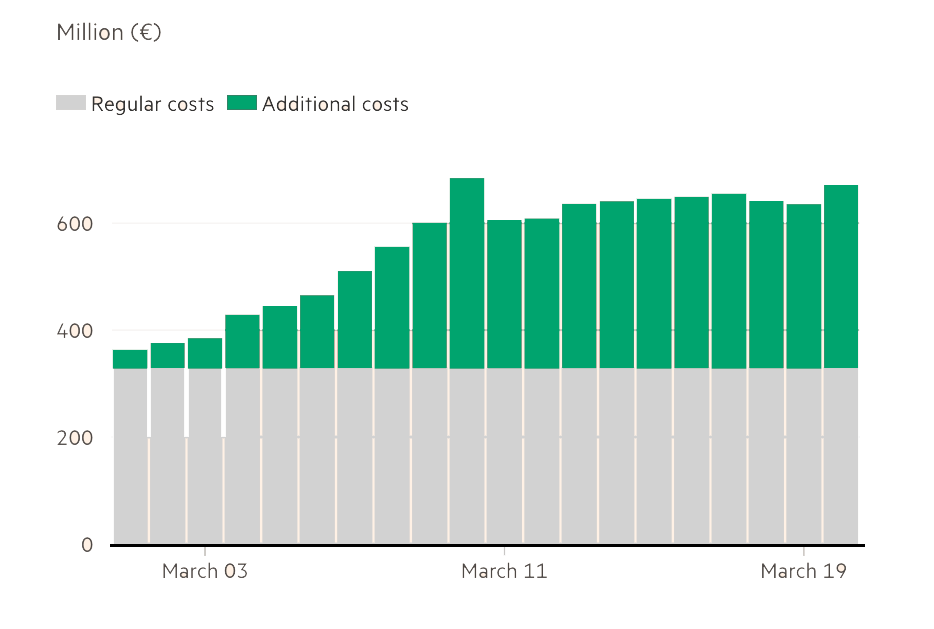
The crisis is adding more than €300M a day to shipping fuel costs.
Source: T&E (2026), based on Clarkson’s World Fleet Register and Stratas Advisors. Fuel costs are sales-weighted by fuel type, mixture and bunkering location: 458 €/t VSLFOeq for conventional liquid fuels, 517 €/t VSLFOeq for LNG
Asia’s Unique Exposure
Asian governments are taking defensive measures to prevent fuel shortages since about 90% of the oil and 83% of the liquefied natural gas that normally passes through the Strait of Hormuz goes to Asia, making the region uniquely dependent on these energy shipments.
- China has intentionally curbed fuel exports to secure its supply
- Airlines are drawing up contingency plans to deal with potential jet fuel shortages as aviation executives have struggled to get assurances about the availability of fuel beyond the next month.
- Many air carriers in the East—Air India, Cathay Pacific, Thai Airways, Qantas, etc.—have already announced plans to raise fares or add surcharges to tickets to cover the higher costs.
- Air China, China Eastern, and China Southern, are uniquely vulnerable to fuel costs as they largely lack fuel hedges and cannot pass on costs to domestic travelers.
- Chinese carriers have increased flights to and from Europe, filling a gap left by Gulf carriers, but they are still losing investor confidence due to soaring fuel costs.
市場動向(続き)
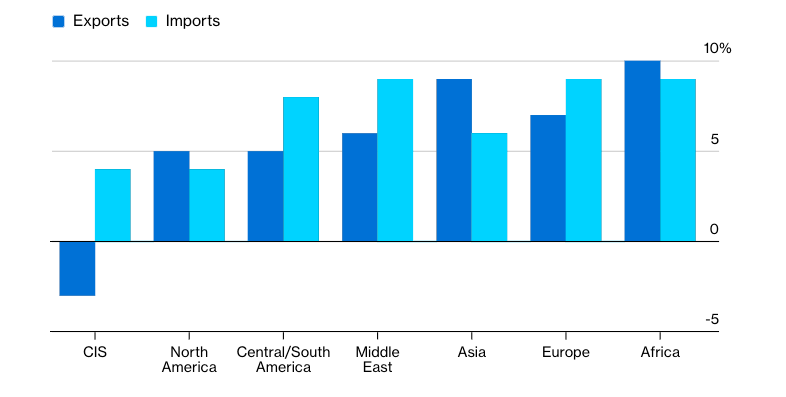
Regional Trade Trends in 2025
North America trailed other major economies amidst U.S. tariffs and geopolitical uncertainty.
Note: % change in USD $ values. Source: World Trade Organization, Bloomberg.

Japan’s bullet train operators are launching high-speed cargo services to offset truck driver shortages and dwindling passenger numbers.

In the past month, Intra-Asia carriers, emboldened by higher rates and consistent demand, have placed a flurry of new vessel orders totaling more than $1B. China-Vietnam trade remains salient in the area, with volumes growing 16% last year to 2.8M TEUs.
Vietnam has overtaken China as the top source for electronics into the U.S., although the core production of those electronics is still happening in China.
- China’s shipments to the U.S. fell by $51B in 2025, but this was largely offset by the United States cumulative $49B rise in imports from other key trade partners like Vietnam, India, and Mexico.
Largest Ocean Carriers Continue Domination
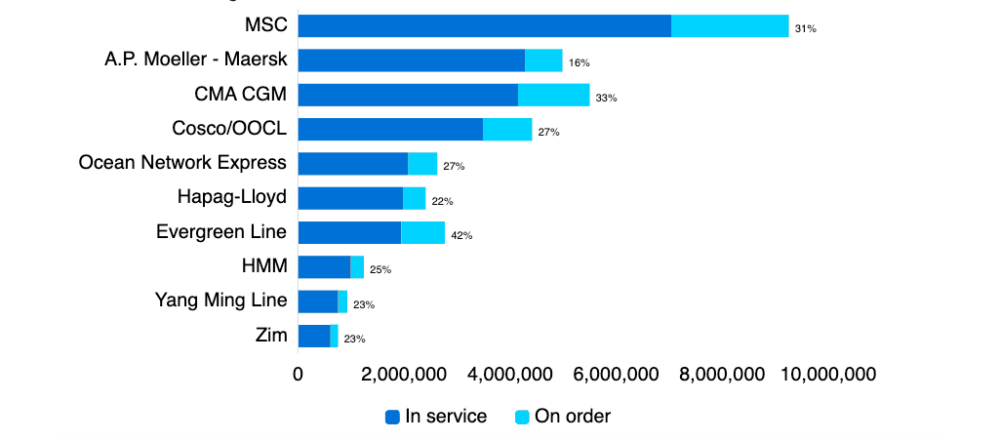
The world’s largest ocean carriers are pursuing relentless growth in strategic ways. Leading container liners are aggressively acquiring terminals and the ships to run regional and feeder systems off those terminals.
- Evergreen continues to grow order book
- CMA CGM is closing in on Maersk with its orderbook
Source: Sea-web, S&P Global.
インフラストラクチャー

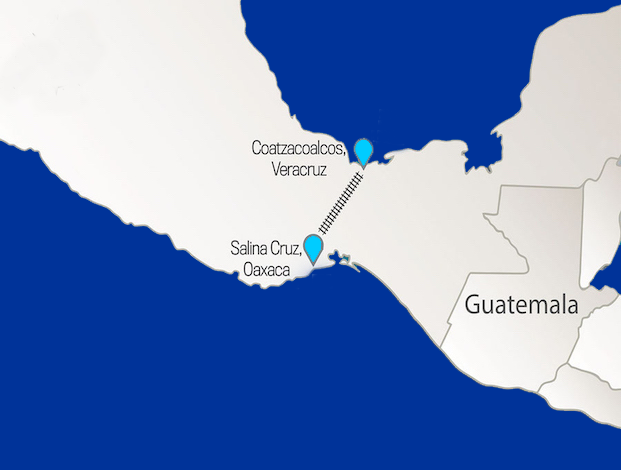
Mexico’s Interoceanic Corridor of the Isthmus of Tehuantepec (CIIT) will be finished soon, with final construction expected in June this year. The CIIT project creates multimodal options, integrating services from Mexico’s National Port System and local administrations with the Tehuantepec Railway.
- CIIT will serve as a long-term alternative to the Panama Canal, which is expected to continue facing droughts that will disrupt operations.

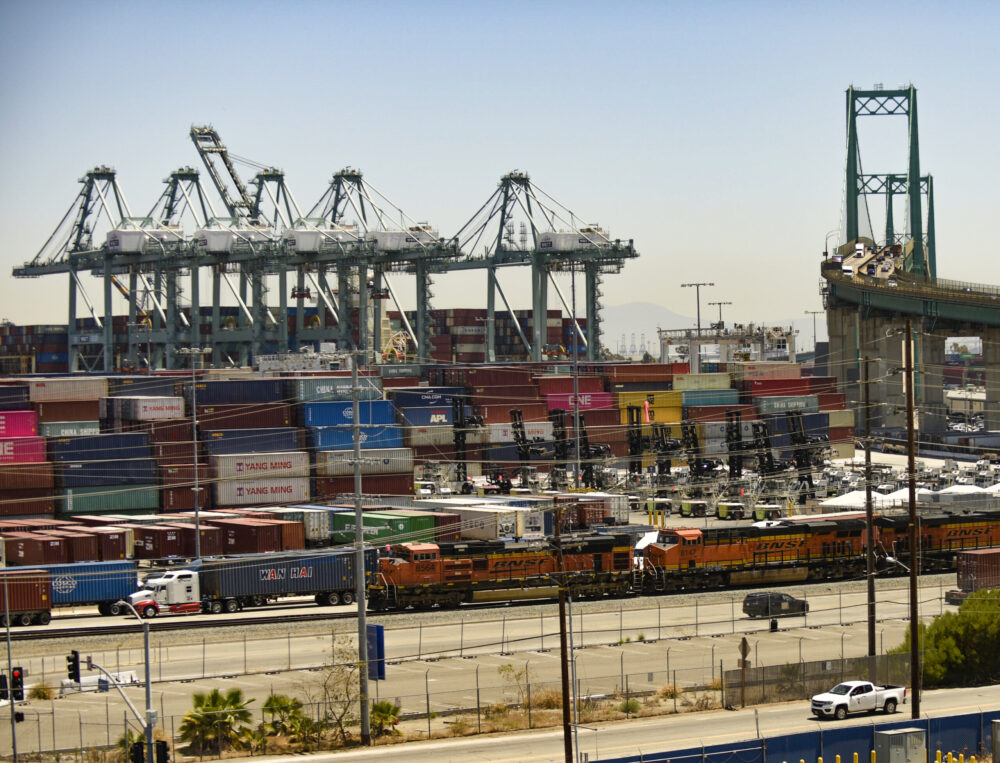
Landlocked Laos will gain direct access to a major port as a new 562km standard-gauge railway in the Laotian capital (Vientiane) will connect with the Vung Ang deep water port on the coast of Vietnam. Daily freight traffic is estimated at >5,000 tons initially, rising to 47,133 tons later.
Vietnam’s government approved a new container terminal near Danang, the country’s third-largest city. Maersk subsidiary APM Terminals and local infrastructure developer Hateco Group have been awarded a 50-year lease to develop the $1.7B Lien Chieu Container Port.
- In its first phase, the deep-sea port will have an annual capacity of 4M TEUs, a total quay length of 2,750 meters, and eight container berths capable of handling vessels up to 18,000 TEUs in size.
- Once fully developed at the end of phase three, the port will have an annual capacity of around 5.7M TEUs.




Tazara & Lobito Projects in Direct Competition
Two major infrastructure projects will connect the same mineral-rich region of central Africa to key ports on the west coast.
Chinese companies plan to upgrade the 1,860km rail line to Dar es Salaam, Tanzania, known as the Tazara railway. These efforts would ease congestion on roads in Zambia and Congo and link Zambia’s copper region to a port on the Indian ocean.
The Tazara link will directly compete with the Lobito Corridor, a rail project backed by the U.S. and EU.
In Dec. ‘25 the U.S. signed a bilateral minerals partnership with the Democratic Republic of Congo that grants American companies preferential access to abundant reserves of metals.

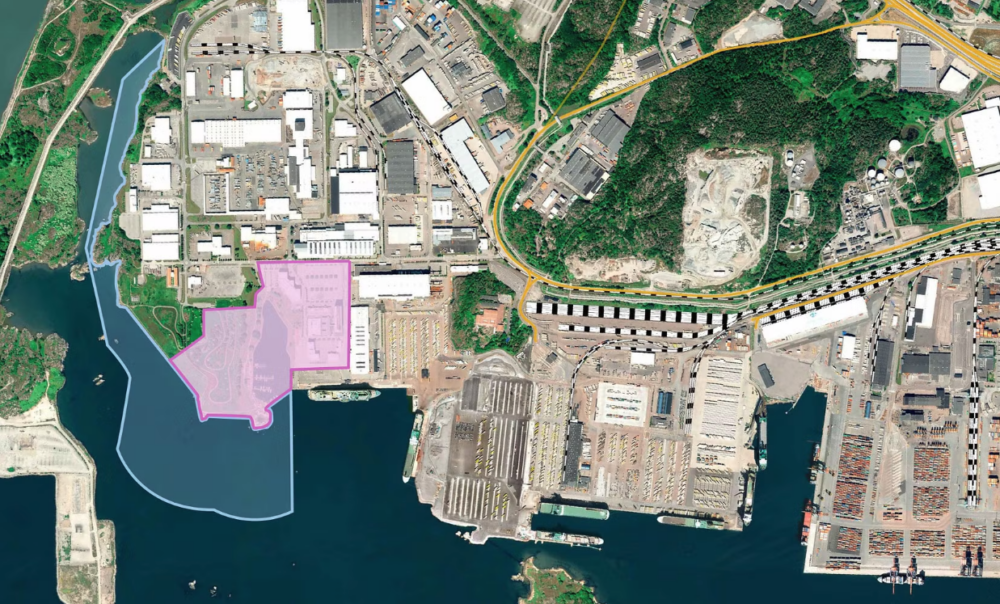
The Port of Gothenburg (Sweden) acquired another large land area (210,000 square meters) in its outer port zone as part of its long-term expansion strategy.

Saudi Ports Authority (Mawani) says operations have started at the new container terminal in Jubail Commercial Port. The terminal’s annual capacity has grown from 1.5M TEUs to 2.4M TEUs across a total area of 460,000 square meters.
- Quay length extended from 1,000 meters to 1,400 meters
- Berth depth increased from 14 meters to 18 meters
- New ship-to-shore (STS) cranes and rubber-tyred gantry (RTG) cranes

Mediterranean Shipping Company (MSC) will develop a new container terminal at Snake Island Port (SIP) in Lagos, Nigeria, as part of MSC’s >$1B of investment in Nigeria’s logistics sector.
- The terminal is designed with a 910-meter quay capable of handling ship-to-shore (STS) cranes and Mobile Harbour Cranes (MHC) for both deep-sea vessels and barges.
- The initial dredging depth is 16.5 meters, matching the current depth of the navigation channel.


Argentina finalized an infrastructure framework for a $4B rail corridor connecting its mining basins in San Juan and Mendoza to the energy basin at Vaca Muerta, with links to Pacific Ocean ports in Chile.
法律と立法

EU customs authorities are increasing scrutiny of small‑parcel and e‑commerce shipments in preparation for the next wave of digitalization reforms. Traders moving low‑value consignments should expect more frequent document requests, tighter data verification, and delays if product information is incomplete or inconsistent.




The U.S. will contribute $250M toward an investment consortium of global trade partners. The fund is part of a broader U.S.-led supply chain alliance known as Pax Silica, which is designed to strengthen supply chains for energy and critical minerals and secure advanced manufacturing. The strategic initiative is also designed to help the countries avoid “single points of failure” within the global supply chain.
- Pax Silica currently includes Japan, India, South Korea, the UK, the United Arab Emirates, Qatar, and Singapore among its members.
Tariffs: Section 232 & IEEPA Refunds
The U.S. recently made significant changes to Section 232 tariffs for key metals and implemented new tariff measures targeting pharmaceutical imports. Additionally, U.S. Customs is progressing on a new initiative—the Consolidated Administration & Processing of Entries (CAPE) system—to refund importers for voided International Emergency Economic Powers Act (IEEPA) tariffs.
Tariffs (continued)
Section 232 Metals
Effective April 6th, 2026, 12:01 a.m. EST
The U.S. will maintain a 50% import tariff on steel, aluminum, and copper commodity imports, but cut duty rates on derivative products made with these metals.
- Tariffs will now be assessed based on the full value of imported goods—not reduced foreign pricing.
- Goods containing 15% or less of these metals are no longer subject to Section 232 tariffs.
50% – Goods made entirely or almost entirely of steel, aluminum, or copper (coils, sheets, etc.)
25% – Derivative products substantially made of these metals
15% – Certain metal-intensive industrial and electrical grid equipment
10% – Products manufactured abroad using entirely U.S.-origin metals

Section 232 Pharmaceuticals
100% tariff on patented pharmaceutical products and ingredients.
- Effective July 31st, 2026, 12:01 a.m. EST for larger companies
- Effective September 29th, 2026, 12:01 a.m. EST for smaller companies
Reduced tariffs (15%) apply to certain places: the EU, Japan, Korea, Switzerland, Liechtenstein, and the UK.
0% tariff available through Jan. 20th, 2029, for companies entering Most Favored Nation (MFN) pricing agreements with the U.S. Department of Health & Human Services, or those signing onshoring agreements with the Department of Commerce. 20% tariff applies if only the onshoring agreements are executed.

IEEPA Tariff Refunds & CAPE Phase 1
U.S. Customs has established a new process—the Consolidated Administration & Processing of Entries (CAPE) system—to refund importers for voided International Emergency Economic Powers Act (IEEPA) tariffs. The Consolidated Administration & Processing of Entries (CAPE) system consists of four steps:
- Claim submission
- Mass processing
- Review and liquidation/reliquidation
- Refund delivery
The agency estimates that it is 45-80% finished with development and testing of the four components. While CAPE represents progress, Phase 1 is limited in scope. Key questions remain around eligibility, timing, and how CAPE may interact with existing strategies, such as filling protests.
Our team has outlined what CAPE Phase 1 includes and excludes, with other key considerations here.
合併と買収
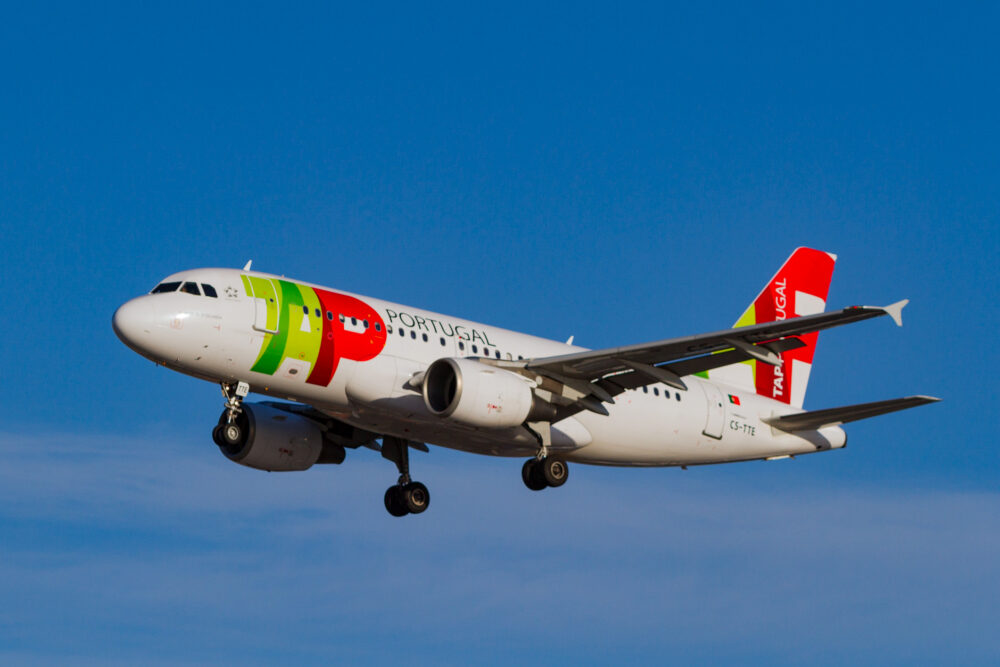
Deutsche Lufthansa AG and Air France-KLM submitted bids for a stake in TAP SA, with the Portuguese government ready to sell as much as 49.9% of its flag carrier.
- TAP has a fleet of 102 planes, mostly from Airbus SE, with 92 currently in service.
- British Airways backed out, with the company’s owner, International Airlines Group (IAG), telling the Portuguese government it will not bid unless rules that prevent it from taking majority control are relaxed.
輸送技術
Huawei and Shandong Port Group launched the Shandong Port Global Smart Port Showcase to jointly develop an all-element intelligent scheduling solution.
Ports must coordinate a wide range of operational elements simultaneously: berths, quay cranes, yard cranes, container trucks, etc., and traditional, manual scheduling methods are increasingly challenged in dynamic operating environments.
This new solution is powered by a large AI model with chain-of-thought reasoning to generate operating plans within minutes, which should provide technical support for more efficient port operations.
“From the security cases we saw with computer vision (CV) large models, AI is no longer just detecting whether someone is wearing a helmet. It understands complex operations, predicts risks, and even optimizes production plans proactively. The idea of AI Agents is already here. The paradigm is shifting from ‘people telling machines what to do’ to ‘machines assisting humans or even making autonomous decisions.’”
– Chen Haiyong, President of Huawei Smart Port Business Unit
HD Hyundai, the world’s largest shipbuilding group, is developing humanoid robot technology to perform precision tasks at its shipyards, most notably, welding. The Korean company has completed a positive evaluation of a prototype’s technical feasibility and on-site applicability, and the project is now moving to the next phase.
A new report projects 170,000 self-driving trucks on U.S. highways by 2035 — roughly 15% of the total trucking market. The analysis also projects $9B in annual consumer savings.
The International Maritime Organization (IMO) approved a global strategy on maritime digitalization, with mandatory cybersecurity measures. The framework promotes interoperability, system standardization, data sharing, and governance across administrations, industry, and seafarers.

Japan Engine Corporation and Kawasaki Heavy Industries demonstrated a large hydrogen-fueled engine in a commercial ocean-going vessel. Notably, most hydrogen engines have been used on smaller coastal vessels, making this a major technological milestone.