出荷番号を入力する。

OIA Global 毎月、包括的な市場レポートを作成している!
これらの有益な資料は、業界をリードするジャーナリスティックな情報源からの情報を用いて、サプライチェーンの重要なニュースやイベントに焦点を当てたものである。各コンテンツの概要と最新版へのリンクは以下の通り。
市場動向
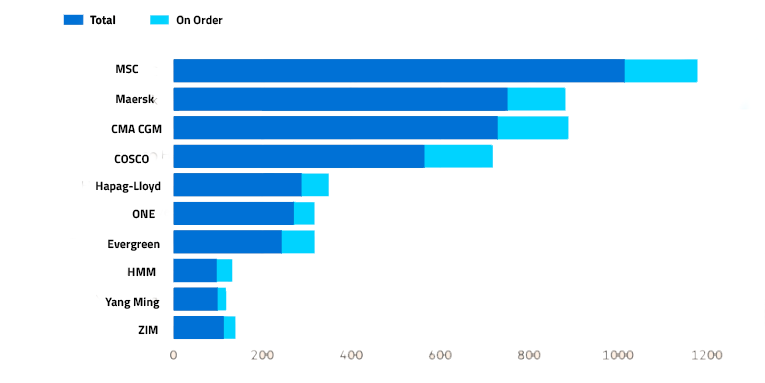
There are 14-16M TEUs of vessel capacity on order, equivalent to >40% of the existing fleet.
Shipping association BIMCO expects fleet capacity to grow +/- 9% in 2027 as deliveries accelerate.
“We are seeing that major carriers are engaging in something of a public relations battle currently to downplay the threat of overcapacity. In our view, overcapacity is simply unavoidable.” – Simon Heaney, Sr. Manager at Drewry
Graphic: Top 10 Carriers (By Fleet Capacity & Orderbook)
Source: Alphaliner, Financial Times.
Steep Rise in U.S. Air Cargo Imports
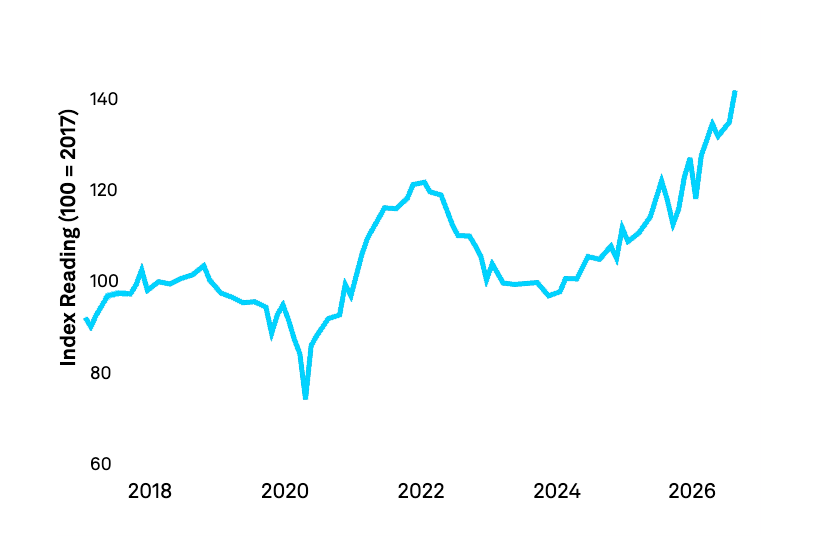
Graphic: U.S. air import tonnage index through August (Seasonally adjusted)
Air cargo carriers are shifting capacity from the Asia-Europe trade lane to the Transpacific, intra-Asia and Africa corridors to support robust demand on routes out of China and Hong Kong.
Source: S&P Global, Census Bureau by Jason Miller.
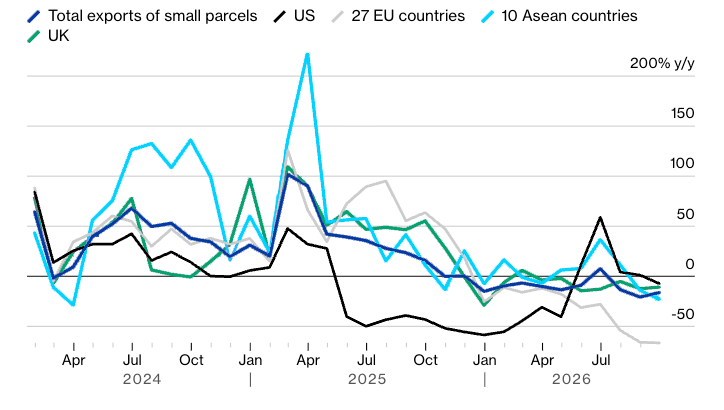
Exports of low-value packages are on the decline in multiple markets.
Source: China’s General Administration of Customs, Bloomberg.

 Trucks hauled $109B in freight across the United States’ borders with Canada/Mexico in August 2026, +29.8% compared with the same month last year. Trucking recorded the largest year-over-year percentage increase among the five transportation modes highlighted in the report.
 India approved INR $100B ($1.05B) to significantly expand the manufacturing of domestic shipping containers, targeting a 10x increase in annual capacity: 70,000 TEU today to 750,000 TEUs in the future. China currently has a near monopoly in the container manufacturing industry.


The EU’s trade gap with China now exceeds €1B (USD $1.1B) a day and is expected to keep growing.
The EU plans to use safeguard measures to cut Chinese imports from specific sectors like chemicals, furniture and machinery. These measures, which could take the form of either import caps or tariffs, may be presented as soon as Q1 2027.
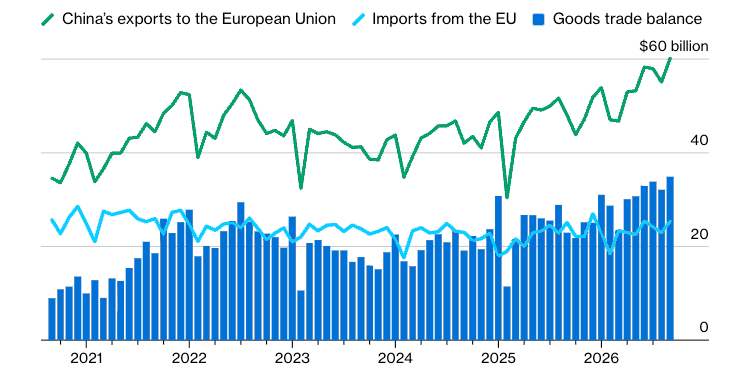
Chinese Trade Volumes Rise
Between January-September 2026, China’s ports handled 275M TEUs, +4.5% year-over-year (YoY), while foreign trade cargo volumes increased 2.9%.
China also introduced a new national rail freight timetable, with 24,000+ freight services now operating across the whole network.
14 new high-speed multimodal trains:
- Xi’an International Port to Wuhudong
- Huangtang to Qiaosi
- Ganzhou International Port to Suzhouxi
17 new regular multimodal trains:
- Baoding to Huangdao
- Jining to Nancang
- Dabaodang to Caofeidian

Arctic Shipping Draws Competition
Melting sea ice continues to open new shipping routes while geopolitical competition is intensifying across the region. Total Northern Sea Route (NSR) cargo traffic has risen from about 3.7M tons in 2014 to >37M tons in each of the past two years.
Russia 
South Korea 
A South Korean containership, the Panstar Acro, completed its first Arctic round trip, a 50-day journey through the Arctic to Europe and back along the NSR.
“Based on this achievement, we will steadily prepare for the Arctic route era.” – Lee Jae-myung, South Korea’s President
“The Arctic navigation data and experience accumulated through this test voyage will serve as precious groundwork for the commercialization of the Northern Sea Route.” – Hwang Jong-woo, South Korea’s Minister of Oceans & Fisheries
EU
The European Union unveiled a new Arctic strategy, which includes a Maritime Security Hub that brings together surveillance and monitoring information from satellites, vessels and seabed infrastructure.
Market Trends (continued)
 Sierra Leone has established a national shipping company—the Sierra Leone Ocean Shipping Company (SLOSCo)—following a joint venture agreement with China’s Zhejiang Xiehai Group. Zhejiang Xiehai owns a 70% majority stake, while the remaining 30% is held by Sierra Leone National Shipping Agency (SLNSA). SLOSCo plans to build a fleet of 50 vessels.
 The U.S. and Denmark signed a maritime cooperation agreement to expand the U.S. shipbuilding workforce and accelerate vessel construction and repairs.
There is growing concern about the veracity of oil shipping prices and how the benchmark is determined, especially as Sinokor’s dominance continues to expand.
- Leasing the largest crude carriers for a 30-day voyage is equivalent to half the cost of building a brand-new vessel, which doesn’t include the cost of the oil itself.
- The last time that newbuilding resales and 5-year-old secondhand tankers were valued above newbuilding contract prices was in 2008.
- Very Large Crude Carriers (VLCCs) have an average rate of $805,000 per day globally, a new all-time high.
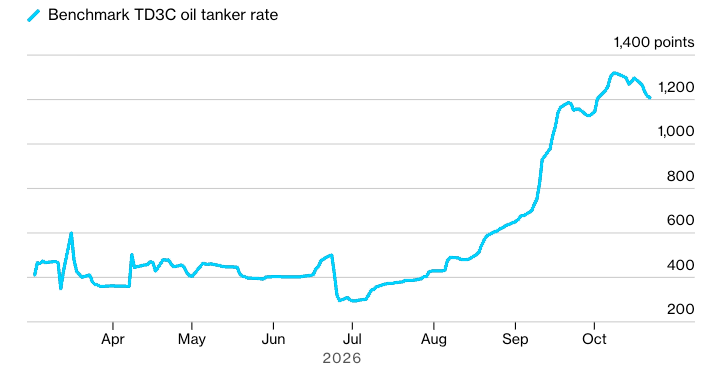
Prices for Very Large Crude Carriers (VLCC) in Millions (USD $)
Source: Poten, Maritime Executive.

Dual-fuel Container Ships & Vehicle Carriers: On Order & Delivered (+29% YoY)
Source: World Shipping Council, GCaptain.

法律と立法
The U.S. Court of International Trade will allow importers to pursue a class-action lawsuit against now-defunct IEEPA tariffs. This would allow a broader range of businesses to obtain refunds, ensuring that all importers who paid the invalidated tariffs have a pathway to reimbursement.
Since September 18th, 2026, U.S. Customs & Border Protection (CBP) voids the importer of record (IOR) number of any importer or broker that fails to provide complete and accurate identity information. A voided number can’t be used to enter goods, so shippers must ensure that their Form 5106 lists the actual business address, email, and phone.
 The Suez Canal Authority (SCA) has introduced mandatory inspections and trials for vessels aged 25 years or more, adding costs and potential delays for operators with older tonnage.
Laws & Legislation (continued)
The EU revised its Union Customs Code (UCC), which will take effect in September 2027. As part of this, the EU will introduce a new EU Customs Authority and Customs Data Hub, creating a more digital and risk-based customs environment.
- Importers will face broader compliance responsibilities: new concepts such as “Trust and Check Traders” will allow qualifying businesses to self-declare customs activities.
As of October 1st, 2026, all importers into Mexico must file the customs valuation declaration (MVE) electronically. Shippers must ensure that commercial invoices, contracts and payment records support the declared value, since this filing provides Mexican customs authorities with better transparency.
On September 22nd, Mexico published the Second Amendment to its 2026 Foreign Trade General Rules, changing the requirements for electronic client files, certifications, and Annex 22. These changes introduced procedures that can lead to suspension when tariff classification codes (NICO numbers) are declared incorrectly. Double check that your classifications are accurate and current!
インフラストラクチャー

Rail Freight
Africa 


The Zambia Lobito Railway project will add 831km of new railway, creating a direct link between Zambia and Angola while avoiding the existing northern connection through the Democratic Republic of Congo (DRC). The new route will reduce transit times to 7 days (16 days via alternative corridors).
Middle East 

The UAE-Jordan freight railway (Aqaba – Al-Shidiyeh – Maan) will include 403km of new track, 55 bridges, 6 tunnels, and is expected to take around 5 years to complete.
Mongolia 
Mongolia opened a new 127km bypass rail line around the capital Ulaanbaatar, which should reroute 20-25M tons of freight annually, reducing congestion and improving speeds overall.
Vietnam 
A.P. Moller-Maersk A/S signed an agreement with Hateco to develop a railway freight terminal network in Vietnam. The proposed network will include a rail freight terminal in Haiphong and three container facilities across northern provinces to connect industrial parks and logistics hubs with major transport hubs.
Growing Multimodal Options in Southeast Asia's Mekong Region



- A rail container yard hub connecting Phnom Penh and Sihanoukville is under development.
- Cambodia/Vietnam movements via Bavet–Moc Bai remain an important corridor.
- More than 21M tons of cross-border cargo have now moved via the China–Laos railway since operations began.
- New cross-border solutions linking Cambodia with Laos and onward to China are supporting temperature-controlled cargo.
Malaysia is strengthening its role as a logistics bridge between Thailand, Singapore and the wider ASEAN region. Improved connectivity is creating opportunities for more integrated landside network access, giving businesses greater routing choice across road and rail.
- South: the Johor–Singapore Special Economic Zone encourages businesses to view Johor and Singapore as one complementary supply-chain ecosystem, combining southern Malaysia’s manufacturing, warehousing and distribution base with Singapore’s international ocean and air connectivity.
- North: stronger road/rail connections are creating additional links between northern Malaysia and Thailand’s manufacturing base.
Maersk’s new Laem Chabang depot, located close to the port, supports direct services, including reefer equipment maintenance and repair, and drop-and-pull operations.
- Expanded barge and inland container depot (ICD) networks support combined barge/truck solutions.
- New corridors around Tay Ninh, Cat Lai, and Cai Mep are strengthening connections in the south, while inland links in northern Vietnam provide alternatives to direct trucking.
Infrastructure (continued)
India
India’s Prime Minister Narendra Modi plans to invest INR $17,000 crore (USD $1.78B) to make V.O. Chidambaranar Port (VOC Port) in Chennai a major container gateway and green energy hub for ultra-large container vessels (ULCVs).
Road Network
India’s new expressways are modeled on American-style infrastructure: access-controlled fast roads that run elevated and far from towns. The government is also setting up a transport planning authority to address wasteful spending and strategy.
- India’s total interstate highway network now covers about 146,000 kilometers, of which 4,500km were built over the past decade.
Regional Comparison
By comparison, China has built >180,000km of freeways since the 1990s, while the U.S. maintains >75,000km of interstate highways.
PhilaPort will build a new 2,000-foot berth at the Southport Marine Terminal—the port’s first new berth in >50 years. The work should increase container handling capacity by 122%, add >6,000 jobs, and generate $45M in annual tax revenue.
- As a specialized mid-Atlantic gateway, Philadelphia handled 889,268 TEUs in 2025, as compared to 8.9M TEUs at New York/New Jersey and 5.7M TEUs at Savannah.
The state’s $371.5 million breaks down into four main pieces:
- $31M for dredging at Southport Berth I
- $145M for reclamation at Southport Berth II and the North Wharf
- $109.4M for land acquisition
- $58.1M for cranes and equipment
合併と買収


Portugal’s government selected Lufthansa’s bid for a minority stake in TAP Air Portugal ahead of the Air France-KLM Group—it was reportedly 16% higher. The deal is set to close in 2028.


Australian infrastructure giant IFM Investors bought a majority stake in Britain’s largest port operator, valuing Associated British Ports at more than £10B.


CMA CGM Group will acquire 49% of the western container terminal at Morocco’s Nador West Med Port. Marsa Maroc will retain the remaining 51% stake.
A.P. Moller Capital (Maersk) agreed to acquire 100% of Portek International from Mitsui & Co. Portek’s terminal interests are spread across Algeria, Gabon, Indonesia, Latvia, Malta, and Vietnam, handling approximately 7M tons of bulk cargo, 700,000 containers, and 90,000 vehicles annually.
Sustainability
The Massachusetts Institute of Technology’s (MIT) Center for Transportation & Logistics recently published its 2026 State of Supply Chain Sustainability Report, which surveyed 1,810 supply chain professionals across 91 countries.
CMA CGM and DSV signed a two-year biofuel agreement with a 12,000 MT CO2e emissions reduction target.
輸送技術
Airbus, a global leader in aerospace technology, and Kpler, a leading provider of global trade intelligence, signed a strategic agreement to deploy daily vessel detection services.
The technology will address a growing challenge for the maritime industry: determining whether a vessel has deliberately switched off or manipulated its AIS signal, or whether its reported position has been affected by interference with satellite navigation systems. By comparing AIS data with independently captured satellite imagery, Kpler says it can better distinguish between the two.
- While some vessels deliberately manipulate their positions to conceal movements, others may report inaccurate locations because of widespread Global Navigation Satellite System (GNSS) interference affecting multiple ships in the same area.
- Identifying this distinction has become increasingly important in major shipping corridors, particularly around conflict zones or sanctioned vessels.
Transport Technology (continued)
HD Hyundai claims to have created the world’s first containership designed to eliminate manual lashing. The 13,000 TEU vessel—recently delivered to CMA CGM—is methanol dual-fueled and has extensive cell guides above deck, allowing containers to be held in place without traditional lashing.
- Lashing remains one of the most labor-intensive jobs in container shipping, as conventional containerships rely on crews or shore workers to secure boxes with steel rods and other equipment.

The U.S. Department of Energy (DOE) and the American Bureau of Shipping (ABS) signed an agreement to advance the use of nuclear power in commercial shipping, including nuclear-powered vessels, floating power plants, and the infrastructure needed to support them.
China Energy Engineering Group (Energy China) claims to have completed the world’s first commercial ship-to-ship bunkering of green ammonia fuel.