Digite o número de sua remessa.

Market Report - 7/2026
Esses documentos informativos e abrangentes destacam notícias e eventos importantes da cadeia de suprimentos, com informações provenientes das principais fontes do setor.
Tendências do mercado
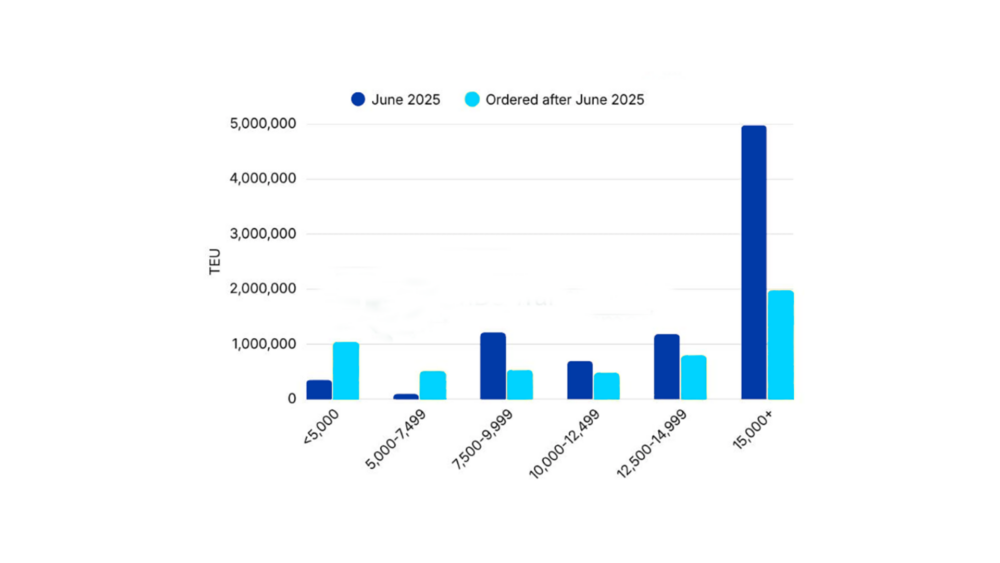
Carriers are opting for smaller and medium-sized tonnage and turning their attention away from megaships. Since July 2025, around 74% of all orders have been for ships <6,500 TEUs.
Overall, the orderbook still remains heavily weighted towards larger ships due to the orders placed in 2023 and 2024. Once those vessels are delivered, capacity in the 18,000+ TEU segment will be roughly double as compared to today.
Source: MDST Containership Databank, SeaTrade Maritime.
The air freight market’s dynamic load factor (space and weight) on services from Asia Pacific to North America currently stands around 90%.
- Semiconductor demand has replaced E-commerce volumes as the main growth driver.
- Airlines are prioritizing long-haul, high-yield routes
- Minor capacity growth is not relieving market pressure

Frontloading Creates Early Peak Season
- TransPacific Eastbound
- Spot Rates: Asia to U.S. West/East Coasts
- Spot Rates: Asia to Mexico/South America West Coasts
U.S. importers are frontloading cargo on the Transpacific eastbound in an attempt to protect inventory against potential tariff changes, fuel volatility, and peak season surcharges.
- June ‘26 import volumes were +14.3% year-over-year (YoY).
- Long Beach showed a +31.7% jump in container volumes during May.
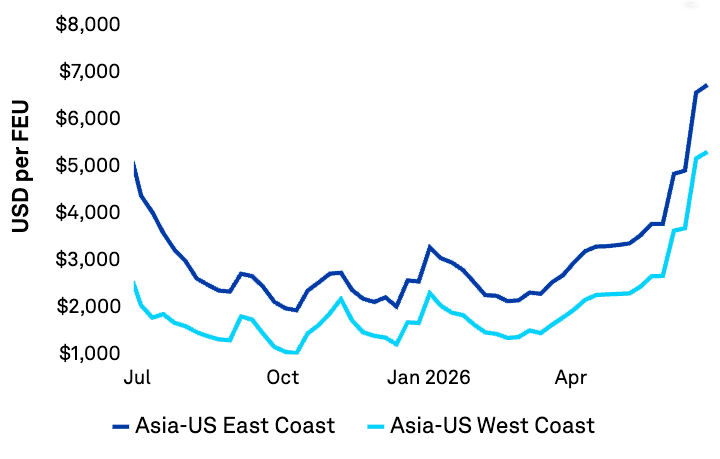
Source: Xeneta, S&P Global.
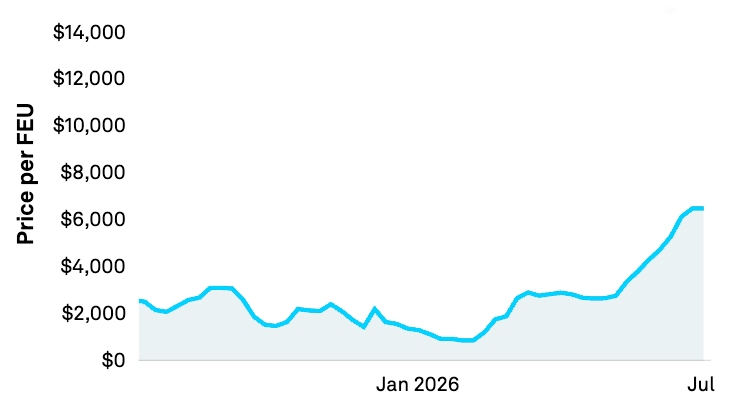
Source: Eternity Group, S&P Global.
Tendências do mercado (continuação)
Amazon Supply Chain Services Now Includes Nationwide LTL Freight
Amazon has expanded its less-than-truckload (LTL) freight beyond inbound shipments to serve all businesses and destinations nationwide.
This complements the recent launch of Amazon Supply Chain Services (ASCS), when businesses of all types and sizes gained access to Amazon’s logistics network, including its entire portfolio of freight, distribution, fulfillment, and parcel shipping solutions.
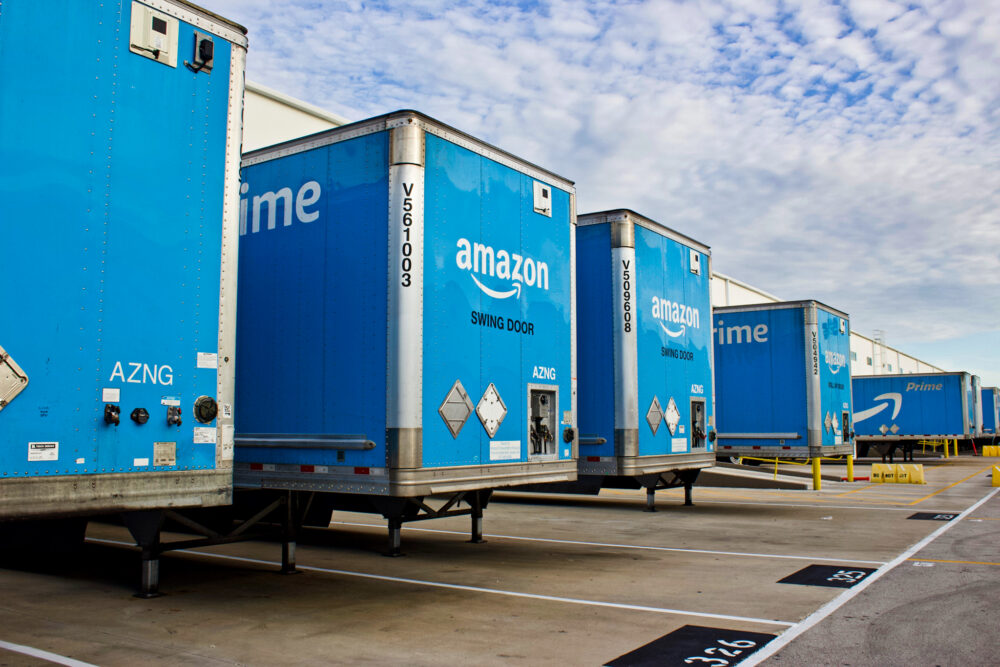
Overall, Amazon’s network includes 200+ U.S. fulfillment centers, 80,000+ trailers, 24,000+ intermodal containers, and 100+ aircraft.
- High fuel prices and rising truck rates are pushing shippers to choose slower, cheaper intermodal options (rail, etc.).
- Container shipping’s traditional hub-and-spoke model is changing as carriers are increasingly moving services away from Asia’s largest transshipment hubs in favor of smaller regional ports.
- Vessels that are 20+ years old now make up nearly 1/4 of the world’s containership fleet—the highest share in decades.

Leis e legislação
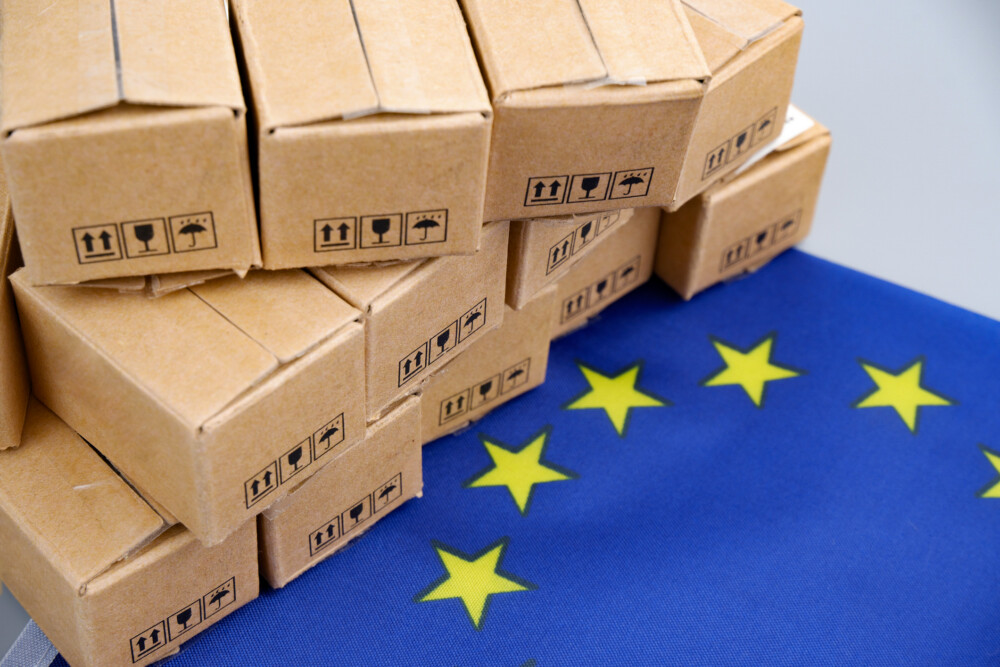
On July 1st, the European Union made significant changes to its customs rules for low-value goods, removing the duty-free exemption.
- For parcels valued at €150 or less, a flat €3 duty will apply per item within a shipment. If a package contains multiple items from different product categories, the duty applies to each distinct category.
What this means for customers: high-volume, low-value shippers will see an immediate impact on their duty bills. OIA offers customs brokerage consultations to help shippers navigate the EU’s complex regulatory environment.
- The flat fee is a temporary regime that’s applicable until July 1st, 2028, pending future implementation of broader customs reforms.
U.S. Strengthens CBP Capabilities & Federal Enforcement
The U.S. is preparing new federal customs regulations, increasing restrictions on foreign importers, and establishing higher penalty thresholds for those who are noncompliant. A recent executive order will strengthen U.S. Customs and Border Protection’s (CBP) capabilities in several ways, with an emphasis on the importer of record (IOR).
Importer of Record (IOR) Changes
- IOR is required to maintain a minimum level of tangible domestic assets, bonds, or both, to ensure compliance with U.S. trade laws. Increases the minimum required bond coverage for an IOR.
- IOR is required to provide CBP with additional data: anticipated import volumes, year organized, ownership and beneficial ownership disclosures, business affiliation disclosures, domestic asset disclosures, etc.
- Creates stricter rules for foreign IORs and companies importing higher volumes of low-value articles.
- Foreign IORs can no longer use an informal entry process for low-value imports and must meet stricter formal-entry requirements. Cannot rely on continuous customs bonds without CBP’s approval.
- IORs may be required to participate in or use brokers that are validated through CBP’s C-TPAT program.
- Establishes heightened import disclosure and certification requirements: foreign tax and global business identifiers, detailed information about the imported good’s supply chain and production methods, such as the manufacturer’s product identifier (e.g., model or style number) or key specifications (e.g., composition, grade, or size).
Forced Labor
CBP Guidance: Forced Labor Enforcement Operational Guidance for Importers
CBP encourages importers to review the new guidance and evaluate whether their current supply chain due diligence and documentation practices align with CBP’s expectations.
Key Considerations:
- Evaluating supplier, manufacturer, and sub-tier supplier relationships for potential forced labor risks.
- Maintaining supporting documentation demonstrating product origin and supply chain traceability.
- Developing internal procedures for responding to CBP detention, exclusion, or redelivery notices.
- Assessing whether existing compliance programs are sufficient to support responses to UFLPA, WRO, Finding, and CAATSA enforcement actions.
Ultimately, the Importer of Record is responsible for exercising reasonable care and maintaining the documentation necessary to substantiate compliance with applicable forced labor laws and regulations.
Risk of Non-Compliance
Failure to adequately address forced labor risks may result in:
- Shipment detentions, exclusions, or seizures by CBP.
- Issuance of Notices of Redelivery.
- Delays in cargo release and supply chain disruptions.
- Increased compliance costs and administrative burdens.
- Potential loss of merchandise if admissibility requirements cannot be satisfied.
- Increased regulatory scrutiny of future imports.
- Importers should ensure they can readily provide supporting documentation and supply chain evidence when requested by CBP.
Trade Fraud Task Force
The U.S. Department of Justice (DOJ) has established a Trade Fraud Task Force to address these critical issues:
- Illegal transshipment maneuvers used to mask the true origin of goods
- Insufficient customs bond requirements (misclassification or undervaluation)
- Importers’ use of shell companies
- Products produced by forced labor
Enhanced Enforcement Measures
- Liquidating damage claims against bonds for noncompliance
- Restricting in-bond utilization
- Increased audits
- Imposing maximum penalties for brokers who fail to conduct due diligence, repeatedly represent noncompliant clients, or fail to cooperate in a timely manner with CBP.
The European Commission has signed onto the Pax Silica initiative, a U.S.-led alliance designed to secure critical minerals, support technology manufacturing, and avoid “single points of failure” within the global supply chain.













Pax Silica members currently include Argentina, Australia, India, Israel, Japan, Qatar, Panama, the Philippines, Singapore, South Korea, Sweden, the United Arab Emirates, and the United Kingdom.
The alliance hopes to impact China’s firm position in these key areas:
- Roughly 70% of the market share for the refining of critical minerals used in AI technologies
- >90% of global production of rare earths used in magnets
- 98% of global production of gallium, a lesser-known mineral needed for high-performance chips that power GPUs and data centers.

Leis e legislação (continuação)
American Supply Chain Sovereignty Initiative
According to the Department of Transportation (DOT), the proposed program would connect ports, ocean carriers, trucking companies, railroads, and major retailers through a centralized freight visibility platform, helping move goods more efficiently and reduce cargo delays.
- The initiative builds on the DOT’s Freight Logistics Optimization Works (FLOW) program, which launched in 2022.


The EU/USA trade deal will finally move forward after the EU bloc gave its final sign-off, ending a year of ratification talks.
- The EU will eliminate tariffs on U.S. industrial goods and some agricultural products in exchange for a 15% tariff ceiling on its exports to the U.S.
- The two sides are still at odds over issues like metals, tariffs, and tech regulations.
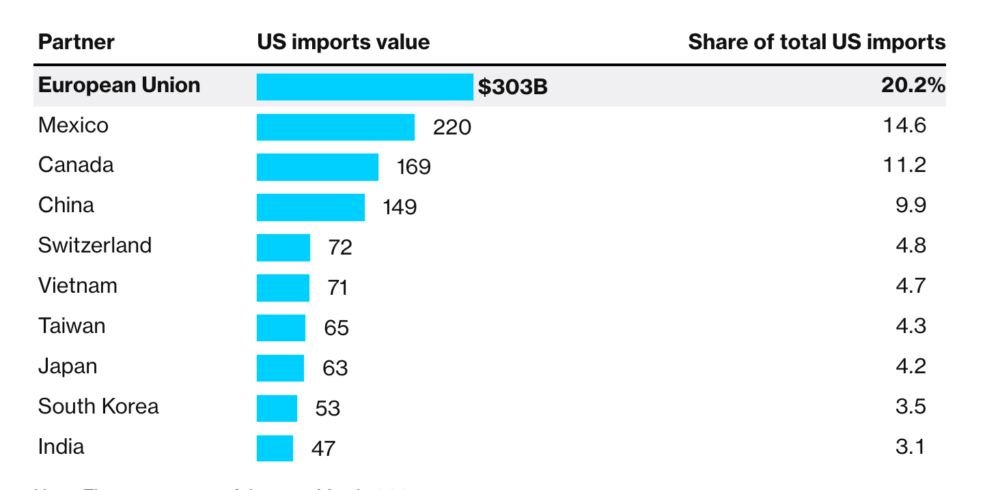
EU Still Remains the Biggest Source of U.S. Imports
Infraestrutura

Vietnam’s Logistics Sector Expands Rapidly
Maersk and Vietnamese conglomerate Hateco are planning to build a new port project in Hanoi. The Giang Bien inland terminal would support freight transport to nearby industrial zones and strengthen links to the Lach Huyen port complex in Haiphong. The project will be developed over a 239,000-square-meter site in two phases, comprising six berths for general cargo and container vessels, along with storage yards, internal roads, and supporting infrastructure.
- Berth Infrastructure: A 600-meter berth designed to accommodate vessels with a deadweight tonnage (DWT) up to 3,000 tons.
- Throughput Capacity: Target operational capacity is 1.0M tons per annum by 2030.
Vietnam’s government approved a new container terminal near Danang, the country’s third-largest city. Maersk subsidiary APM Terminals and local infrastructure developer Hateco Group have been awarded a 50-year lease to develop the $1.7B Lien Chieu Container Port.
- In its first phase, the deep-sea port will have an annual capacity of 4M TEUs, a total quay length of 2,750 meters, and eight container berths capable of handling vessels up to 18,000 TEUs in size.
- Once fully developed at the end of phase three, the port will have an annual capacity of around 5.7M TEUs.

Landlocked Laos will gain direct access to a major port as a new 562km standard-gauge railway in the Laotian capital (Vientiane) will connect with the Vung Ang deep water port on the coast of Vietnam. Daily freight traffic is estimated at >5,000 tons initially, rising to 47,133 tons later.

- For intra-Asia trade, China-Vietnam trade flows remain salient, with volumes growing 16% last year to 2.8M TEUs.
- Vietnam has overtaken China as the top source for electronics into the U.S., although the core production of those electronics is still happening in China.
Infrastructure (continued)

Turkey’s Minister of Transport & Infrastructure, Abdulkadir Uraloğlu, says a direct rail connection between Saudi Arabia, Jordan, Syria and Turkey will happen “within the next three or four years,” following the signing of several documents related to the project. Roughly 400km of new infrastructure is expected between Syria and Jordan.

CMA CGM signed an agreement with Oman’s Asyad Group to develop and operate a new multipurpose logistics terminal in Sohar, one of Oman’s main logistics hubs.
Virginia/Georgia Compete for East Coast Supremacy
After completing a $450M harbor deepening and widening project, the Port of Virginia (Norfolk) officially has the deepest commercial shipping channel on the U.S. East Coast at 55’. The expanded waterway allows for two-way traffic of ultra-large container vessels (ULCVs)—typically 14,500- to 24,000-container capacity.
- The program includes a fully operational $83M rail expansion, which will boost annual capacity to 2M 20’ TEUs.
- $220M conversion of the Portsmouth Marine Terminal into a deepwater heavy-lift facility.
- $650M renovation and reconfiguration of the North Berth at Norfolk International Terminals remains in progress, with completion expected in mid-2027.
Georgia Ports Authority (GPA) recently passed the halfway mark on its $1.6B expansion of Savannah’s ocean terminal. Redevelopment of the 200-acre facility is expected to increase Savannah’s annual container capacity from 200,000 TEUs to 1.75M TEUs.
The upgraded yard is expected to partially open in late 2027, with full completion by the end of 2028.

Sustentabilidade
Long Beach Enacts Different ESG Initiatives
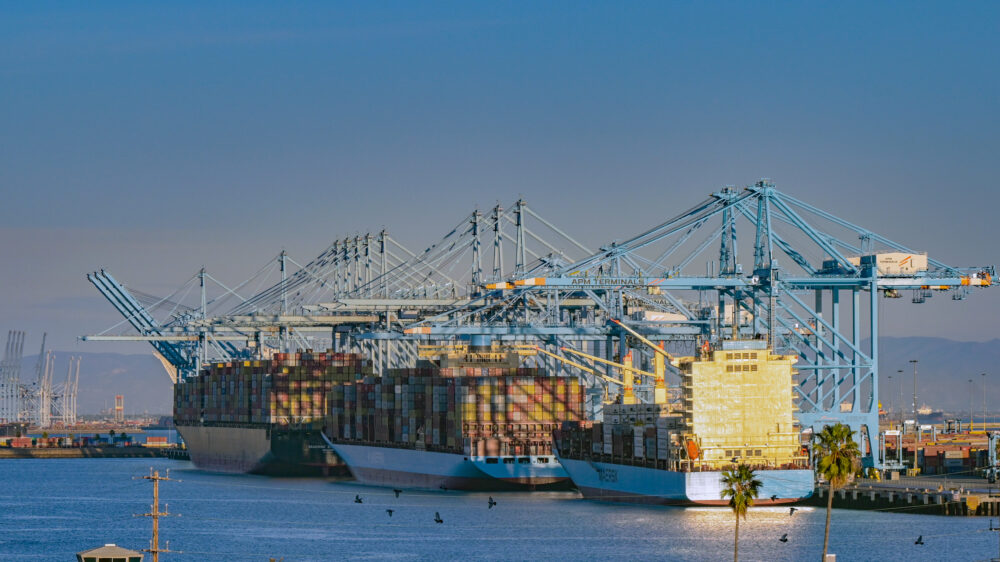
The Port of Long Beach continues to enact strategic ESG initiatives as part of its long-term objective of becoming the world’s first zero-emissions port. Different partnerships aim to improve supply chain efficiency while also reducing air pollution and greenhouse gas emissions.
- Authorizing $58M to expand its zero-emissions cargo handling equipment and replace diesel-powered harbor craft with lower-emissions ships.
- Financially incentivizing trucking companies that deploy zero-emission vehicles at their marine terminals.
- Establishing a “green trucking corridor” between Los Angeles and California’s central valley.
Sustainability (continued)
The International Air Transport Association (IATA) has been extremely critical of Sustainable Airfreight Fuel (SAF) production, usage, and targets, particularly throughout Europe.
“The 2030 e-SAF targets by the UK and the EU are beyond unrealistic—they are utterly detached from reality. It is a reckless energy market creation strategy to impose mandates before production is enabled. Such a strategy will only drive up the price. Coupled with penalties, it diverts scarce resources from being allocated to actual CO2 emissions reductions.”
– Marie Owens Thomsen, IATA’s senior vice president of sustainability and chief economist.
Onboard Carbon Capture & Storage
Onboard carbon capture and storage (OCCS) systems are ready for ships but are constrained by the limitations ashore. The ships still require proper port-side infrastructure, access to storage, and carbon accounting methodologies.
- The shipping industry needs to reach consensus on the economics of captured CO2— getting it off the ship and into a verified value chain. Whether the captured CO2 is classified as waste, a commodity, or something else will determine what that market is worth.
- The benefit of OCCS is that it’s very traceable and measurable. Alternative fuels often carry layers of upstream opacity that make lifecycle emissions difficult to track. A capture system generates a far tighter, more defensible data chain from the exhaust inlet to permanent storage.

Tecnologia de Transporte
Samsara has introduced a smart tracking label that creates a new, lower-cost option for continuous shipment monitoring. This printable, single-use sticker can stick to a package or pallet and connect with millions of other Samsara devices installed on trucks, trailers, vehicles, and other equipment. The disposable labels have no lithium or hazardous materials, so they can be used for air, ground, and rail shipments, on virtually all major U.S. roads and at facilities across the country.
Volvo Leading the Way in Autonomous Trucking
Volvo will start driverless trucking operations on U.S. highways soon, with 300+ autonomous rigs expected to be operational by the end of 2027. Volvo expects revenue from autonomous transportation to reach $3B within five years.
- Waabi’s AI-powered virtual driver can now operate a new truck platform without requiring additional training, engineering or data collection—it allows a single AI driving system to transfer seamlessly between different vehicle platforms. This is an important step toward making autonomous trucking technologies scalable and commercially viable.
- Volvo and technology firm AVI-SPL are currently testing a route between Dallas and Houston, Texas, to see how their autonomous vehicles perform.

China Airlines added an AI customer service assistant for its cargo business. The service connects with air cargo scheduling systems to provide three core services: flight information, shipment tracking, and cargo regulations. It should also speed up answers to customer inquiries.
Conteúdo relacionado
-
Recent Changes in the EU’s Customs Rules
EU finalizes its trade agreement with the U.S. and introduces new customs rules for low value goods
-
Atualizações sobre a cadeia de abastecimento no Oriente Médio
The situation in the Persian Gulf remains fluid, and this page will be updated as new developments occur.
-

Relatório mensal de mercado
Esses documentos informativos e abrangentes destacam notícias e eventos importantes da cadeia de suprimentos, com informações provenientes das principais fontes do setor.